
The Information Center
Things go in, and later you can find them again. Most of them will not tell you about the utility bill that never arrived, because a bill that did not come has no transaction to notice. And that is the one that costs you.
Two lists, deliberately, because a product that puts everything in one list teaches you to ignore the list. One is things with a consequence attached and usually a date. The other is things you would want to know and nothing bad happens today.

None of this is data anybody entered. Because Global Office: Sync read every line rather than a total, it can compare one document with another, and things fall out that nobody typed in.
Contractor Edition
You drove to Springfield on a Tuesday. There's a hardware receipt from Springfield that same Tuesday. Same job? Now you know what that job really cost.
A subcontractor's coverage lapsed in July and they are on site right now. If your insurer audits you, they can call that person your employee and charge you premium on every dollar you ever paid them.
That invoice has been sitting unpaid for 71 days. That's your money, in someone else's account.
And a quiet one that people tend to sit with for a moment: you quoted eighteen hundred on that job, and you invoiced sixteen fifty. Seeing that once will change what you charge on the next one.
Compliance findings. A certificate that has expired, one expiring within thirty days, one that never covered the work that was done, one reissued with less cover than the last, and one made out to a different company, which is in force and is not covering you.
Tax document findings. Which subcontractor will need a 1099, the payment that took them over the line and the date it happened, who is missing a W-9, and what is still needed before a form can be filed.
Findings across records. A charge on the card with no receipt behind it. A quote past its expiry with nothing invoiced against it. An invoice that went out for less than the quote. A utility bill that never arrived this month, noticed by its absence rather than by a transaction.
Findings about money owed. Bills past due by date rather than by count, the oldest first and per provider. Invoices nobody has chased. Money you have paid with nothing on file to show for it, which is almost always a check in the post and is the first spending an examiner asks about.
A lapsed certificate appears in three separate places, because the cost of missing that one is not the same as the cost of seeing it twice.
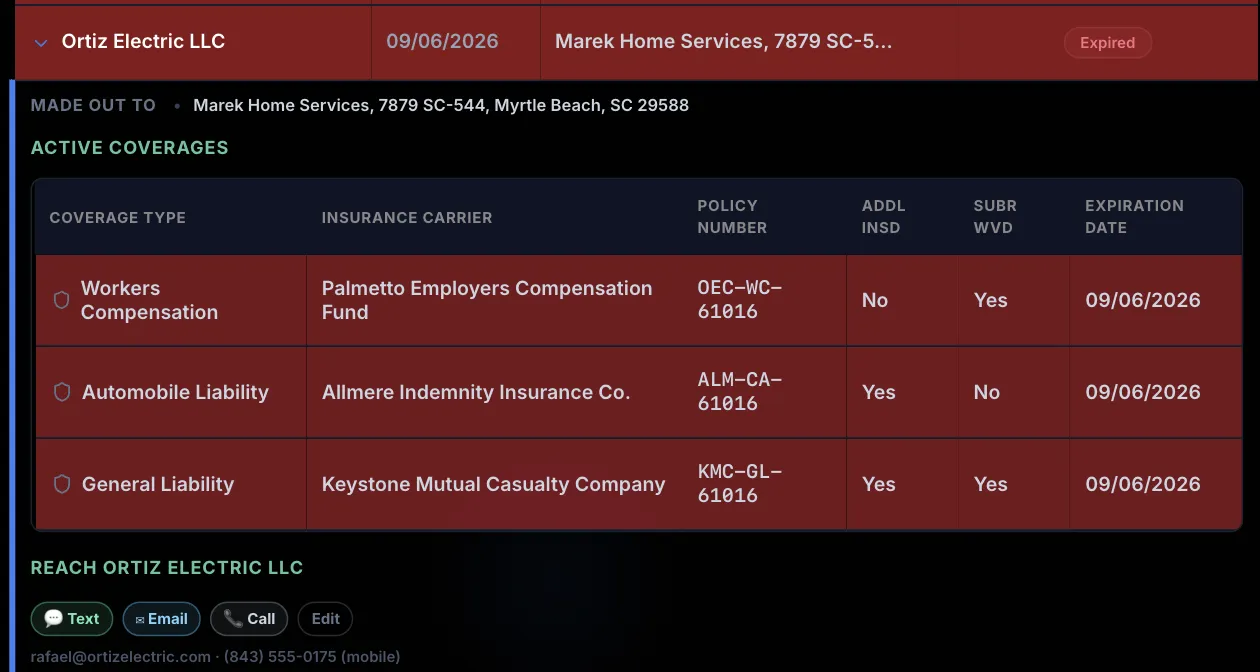
Open one and every coverage on it is listed, with the carrier, the policy number and the date it ran out. A certificate made out to a different company is flagged in amber and labeled as such, because in force is not the same as covering you.
One certificate is commonly several ledger rows: workers compensation, automobile liability and general liability each carry their own limits and their own expiry, so each is watched on its own rather than the document being treated as one date.
Tax Docs
That is a rule you could look up. This names the subcontractor, the payment that took them over the line, and what you still need before you can file. Nothing is late when it says so, which is the point: chasing an address and a tax number in January is the part that goes wrong.
Tax identification numbers are stored locked, and shown as dots.
