
If the business is yours · Contractor Edition
Every competing product is fed by a bank feed, and a bank line reads HOME DEPOT $450. It has no line items and it does not say what was bought. Global Office: Sync reads the lines.
One · Open the business
Full Edition opens on a whole practice because a bookkeeper has a roster. You have one business, so the first screen is a different screen: whose insurance and W-9s are in order, which charges have no paper behind them, and which jobs made you anything.

Three things across the top. Compliance, tax forms, and how much of your card and bank spending has a document or a written reason behind it. On the screen above: all six subcontractors covered, two who will need a 1099 on $6,090.00 paid, and 72 of 95 charges documented at 76%.
A card for each ledger. Receipts, income, utilities, mileage and quotes, each with its total and its count, and each one the same figure that ledger's own pill shows, so the dashboard can never quietly disagree with the ledger behind it.
What needs attention, and what is only worth knowing. Two lists, because one list teaches you to ignore the list. Each finding carries the control that settles it: open the coverage, open the quotes, reconnect the books.
How ready the people working for you are. Ready to work, cover expiring within thirty days, no cover at all, no W-9, and a certificate that names somebody else. Press one of those and the Compliance ledger opens filtered to exactly those people. It does not touch the jobs table, because they are answers to different questions.
Every job in one table. Money in, money out, what is left, the miles, and when something last happened on it. Mileage is a deduction and is deliberately not counted in what a job cost. Press a job and every ledger opens filtered to it, carrying the dates you were looking at.
And it is where the app opens. Choosing a ledger leaves it, and the Dashboard button in the middle of the bottom bar brings it back.
Two · Get the paperwork in
Not a companion app with three buttons on it. The same ledgers, the same findings, the same jobs, on the screen you actually have with you. Photograph it now and deal with it tonight.


Three · Understand the jobs
A job is whatever you type, and the list suggests itself from the jobs already in use. Anything that made you build a list first would be asking you to do paperwork in order to file paperwork.
Hardly anyone knows what share of their year rode on their biggest job, because working it out means adding up a year of jobs by hand. One glance at the wheel and you can see it. Eleven percent is one answer. Sixty is a very different one.
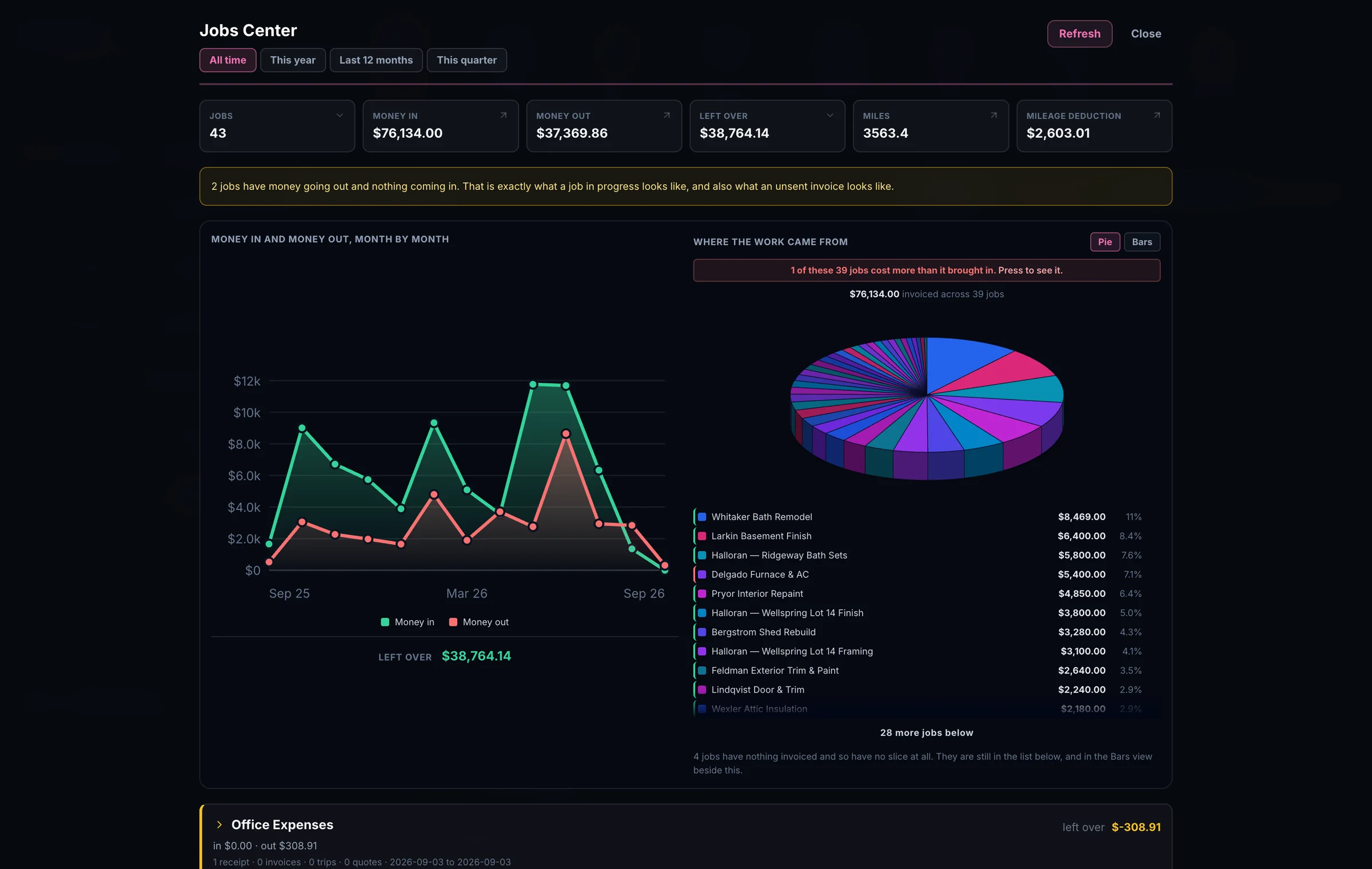
Open one and it shows you. This one invoiced $5,400 and spent $5,788.42 on four suppliers, so it lost $388.42. Nobody was ever going to work that out until the end of the year, and by then it would be too late to price the next one differently.
The invoice, every receipt that went into it, and all six trips are on the same screen, each one still one press from the photograph it came off.
One of these 43 jobs cost more than it brought in. Global Office: Sync found it from paper you'd already scanned.
What you earned, and how much of it was your own work. An invoice total doesn't say how much was your time and how much was materials you bought and passed through at cost. $65,679 of your own work against $10,455 of materials is the number that decides whether you are busy or profitable.
What you spent it on, not which supplier. Lumber, roofing, fasteners, subcontracted labor. Sync already read the lines on your receipts, so there is nothing to set up first.
What the driving is worth. Not that you drove 63.5 miles. $3,077.30 across 255 trips and 42 jobs, each valued at the IRS rate in force on the day it was driven. Not this year's rate. That day's rate.
Which bills are overdue, and since when. Not a count, a date. Five past due and the oldest was due July 20th, per provider, with what falls due in the next two weeks beside it. Settling one records a real payment, so a bill can be part paid, paid two ways, or taken back.
What you last paid for a thing, and where. $42.99 a pack all year and this one was $44.99, put in front of you while you are searching. That is not a record of money already spent. It is the number you need when you are pricing the next job.
Everyone you deal with, named by your own paperwork. You never built this list. It assembled itself out of the documents you photographed, with the phone number and email you already had for each person.
Four · Keep the subcontractor records ready
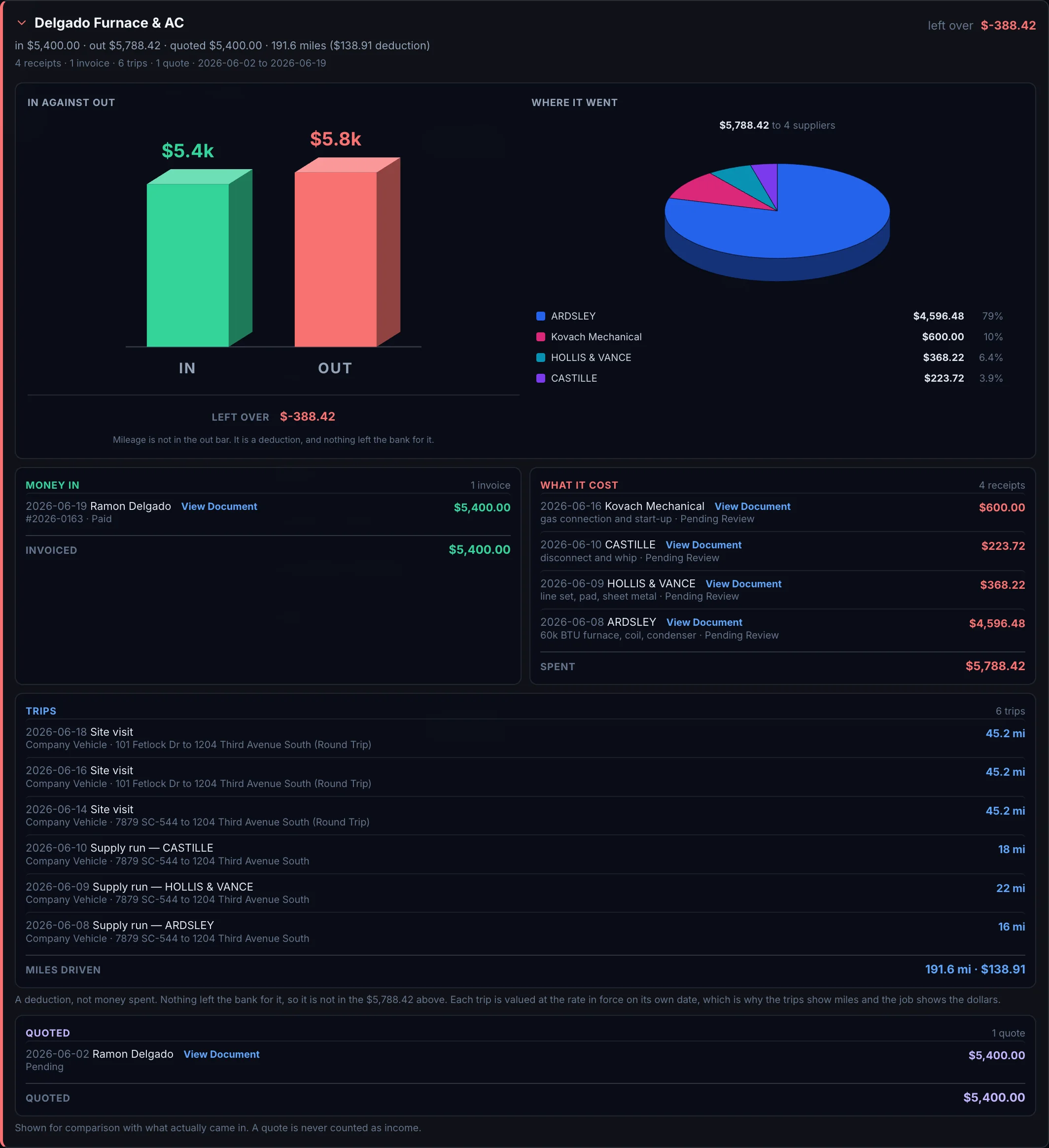
A contractor who hires subcontractors is the person who needs certificate expiry watched most, so Global Office: Sync tells you three separate times. Once is once you can miss.
Open a certificate and every coverage on it is listed, with the carrier, the policy number and the date it ran out. A certificate made out to a different company is flagged too, in amber rather than red and labeled as such, because in force is not the same as covering you.
If your insurer audits you, they can call an uncovered subcontractor your employee and charge you premium on every dollar you ever paid them.
The argument at a workers' compensation audit is always about who counts as your employee, and it is won with paper you either have or do not.
Tax forms
That is a rule you could look up. This names the subcontractor, the payment that took them over the line, the date it happened, and what you still need before you can file. Nothing is late when it says so, which is the point: chasing an address and a tax number in January is the part that goes wrong.
Sync knows a hardware store from a person you paid to work, collects W-9s, and reads the 1099 family that comes back. Tax identification numbers are stored locked and shown as dots.

Five · Find the missing paperwork
Connect a bank or card account and Global Office: Sync holds every charge up against the receipts, bills and invoices it already has. What comes back is the list of charges with nothing behind them, which is the first spending an examiner asks about.

Six · Connect to your bookkeeper
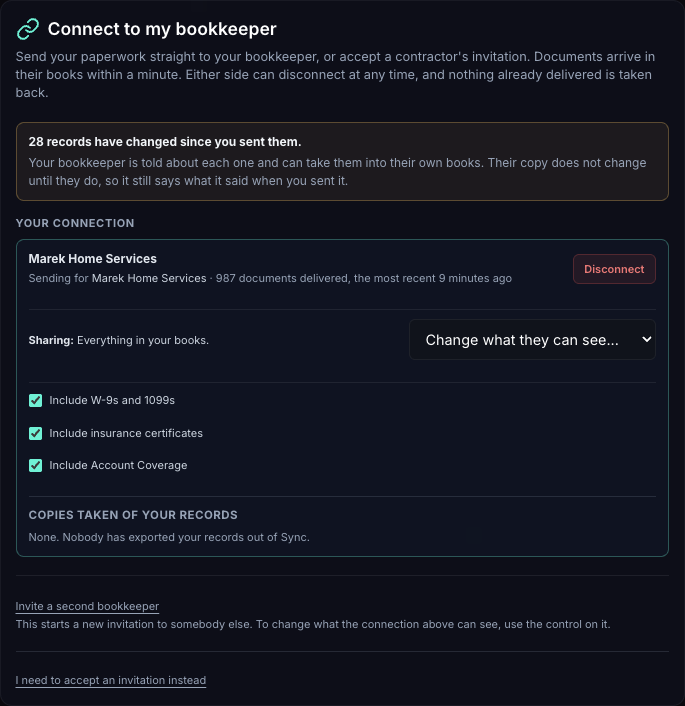
Approved records cross over as copies with the document attached. You decide how far back the bookkeeper can see and whether your Account Coverage goes too, and you can change either later. Your business details travel with the invitation, and either side can cut the link at any time.
The bookkeeper can mark a bill paid and you are told within the minute. Nothing else crosses back: they can say what they did, and they cannot change what you said.
If nobody does your books, the same records go straight out to QuickBooks Online, Xero or FreshBooks instead. Nothing here needs a bookkeeper on the other end.
Seven · Hand over something supported
You are never shown an account column and never asked to build a list. Global Office: Sync does the matching silently on the way to QuickBooks Online, Xero or FreshBooks, with the photograph attached to the transaction on the accounting side rather than left behind here.
You buy it once and own it. There is nothing to install: it runs in the browser, adds itself to your home screen, and updates itself with no app store in the way.