
Contractor Edition
You drove to Springfield on a Tuesday. There's a hardware receipt from Springfield that same Tuesday. Same job? Now you know what that job really cost.
A subcontractor's coverage lapsed in July and they are on site right now. If your insurer audits you, they can call that person your employee and charge you premium on every dollar you ever paid them.
That invoice has been sitting unpaid for 71 days. That's your money, in someone else's account.
And a quiet one that people tend to sit with for a moment: you quoted eighteen hundred on that job, and you invoiced sixteen fifty. Seeing that once will change what you charge on the next one.

None of that is data you entered. Global Office: Sync found all of it, and told you while you could still do something about it.
It's what happens when the paper finally has something to talk to.
And nothing gets filed without you saying so.
Ever.
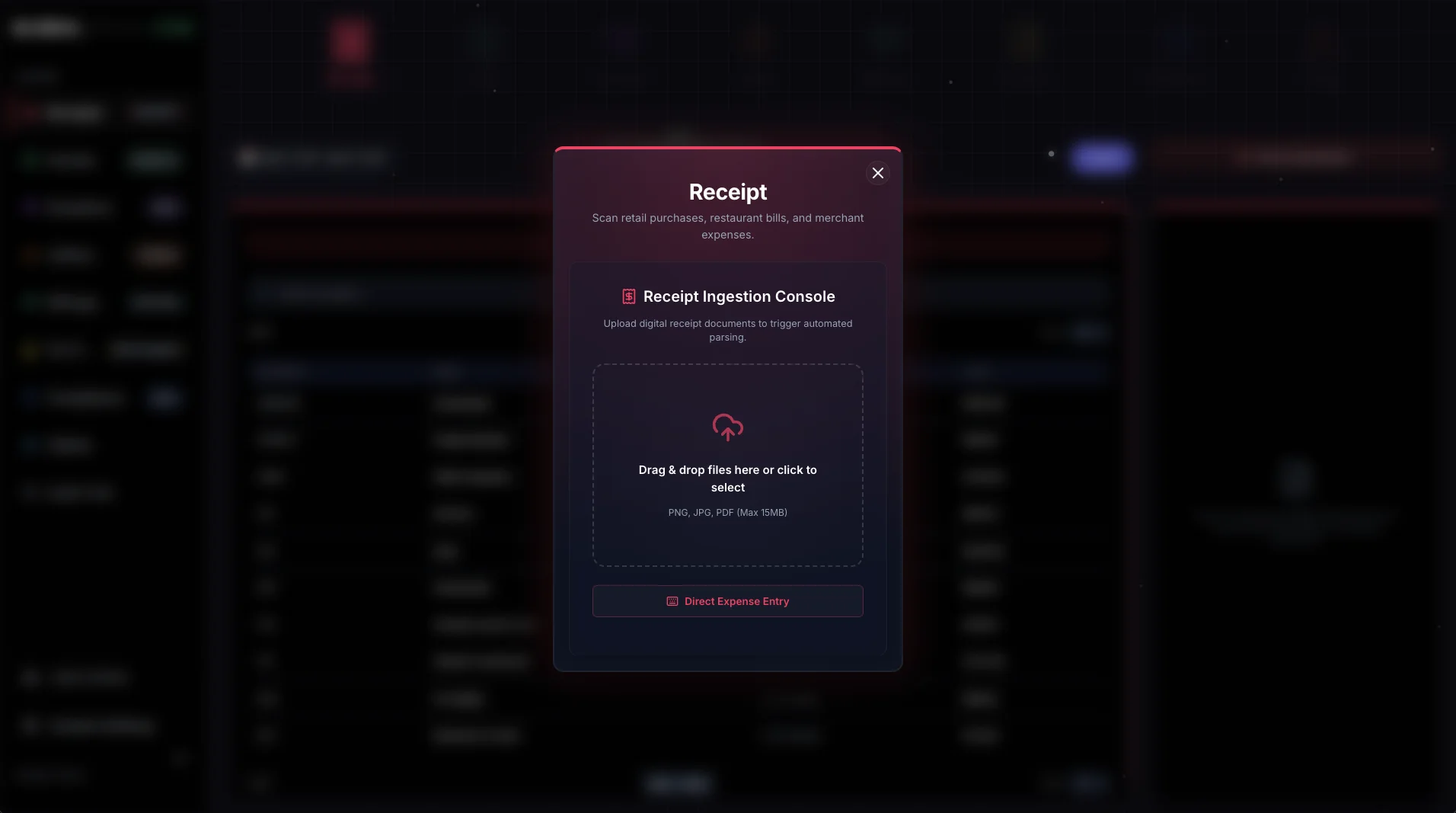
Photograph a document, drop in a PDF, or hand over a folder of hundreds at once. Nothing has to be sorted first. A blurry or dark photo is caught on the phone before it is sent, with the choice to retake it or use it anyway. Things with no document get typed straight in, and a loan or credit card payment is split into the interest, which is deductible, and the principal, which never is.
Not just the total. Line items, tax, shipping, dates, the payer block on a 1099, the coverages on an insurance certificate. Then it proposes a category, matched against a real chart of accounts rather than a generic list.
One screen, with the photograph beside the numbers. Anything that needs a second look says why in words rather than in a color. Lines it is not confident about are marked and left blank, because a product that guesses rather than leave a box empty has just made you check every box.
In a ledger built for that document type, and out to QuickBooks Online, Xero or FreshBooks with the photograph attached. Sync will not send the same record twice, and it remembers your correction for next time.


If you do the books for other people
A bookkeeper's rate is built on knowing where things go, catching what is wrong, and standing behind the result. None of that is the part that takes the time.
Global Office: Sync handles the part that takes the time. It reads receipts, invoices, utility statements, certificates of insurance, 1099s and W-9s, pulls every field, matches line items against that client's own chart of accounts, and proposes the entry.
Everything you actually bill for, you still do. Everything else stops being yours.
Which means the same fee covers less of your day. Take more clients at that rate, or keep the roster and get the hours back. That's the whole pitch, and it's simple arithmetic.

No more 'Uncategorized'. Global Office: Sync matches line items against that client's actual chart of accounts, with their account numbers intact. Account 090 stays 090. What it cannot place is marked and named, and comes back to you as a question rather than being swept into a catch-all.
Chasing clients for paperwork. A client on Contractor Edition sends their documents to your roster on their own. No emailed archives, no "did you get my receipts," no asking twice. The ones who never will get a link they open on their phone. Every hour you have ever spent chasing paper was unbilled.
The client you have not opened since April. Global Office: Sync watches every client on the roster, not only the one in front of you. Finding out in August that a certificate lapsed in July is finding out too late.
Setting up a new one. Pull their chart straight out of their QuickBooks or Xero, upload it, or start from one of six that ship with Sync. You are not retyping somebody's chart of accounts at nine at night ever again.
January. You know before December which subcontractors are missing a W-9, which client crossed the threshold and on what date, and which certificates lapsed during the year. 1099 season stops being a scramble because the work was done in March.
And Sync gets cheaper as it goes. Categorize something once and it stays categorized that way for that client. Month six costs you less time than month one, and across a roster that compounds.
The practice dashboard · Full Edition
With no client picked, Full Edition opens on everybody you look after. The question you open it with is what needs you today, and whose is it. That's the first thing on the screen.

What needs attention, across every client. One line per finding, with the client's name on it and the button that deals with it. Press a line and its full card opens in the Information Center, which stays open beside the dashboard.
A card for each ledger. The total, the count, and one line in words saying whether the work is up or down on the period before. It counts records rather than dollars, because your week is shaped by three hundred receipts, not by what they add up to.
Where your clients stand. How many need attention, how many have something worth knowing, and how many are all clear. Press one to list those clients.
Every client in one table. What needs attention, receipts, income, past due bills, miles, and the day something was last added, which is the column that tells you who you haven't heard from. Press a client to open their books.
If the business is yours
Every competing product is fed by a bank feed, and a bank line reads HOME DEPOT $450. It has no line items and it does not say what was bought.
Global Office: Sync reads the lines.
Jobs Center
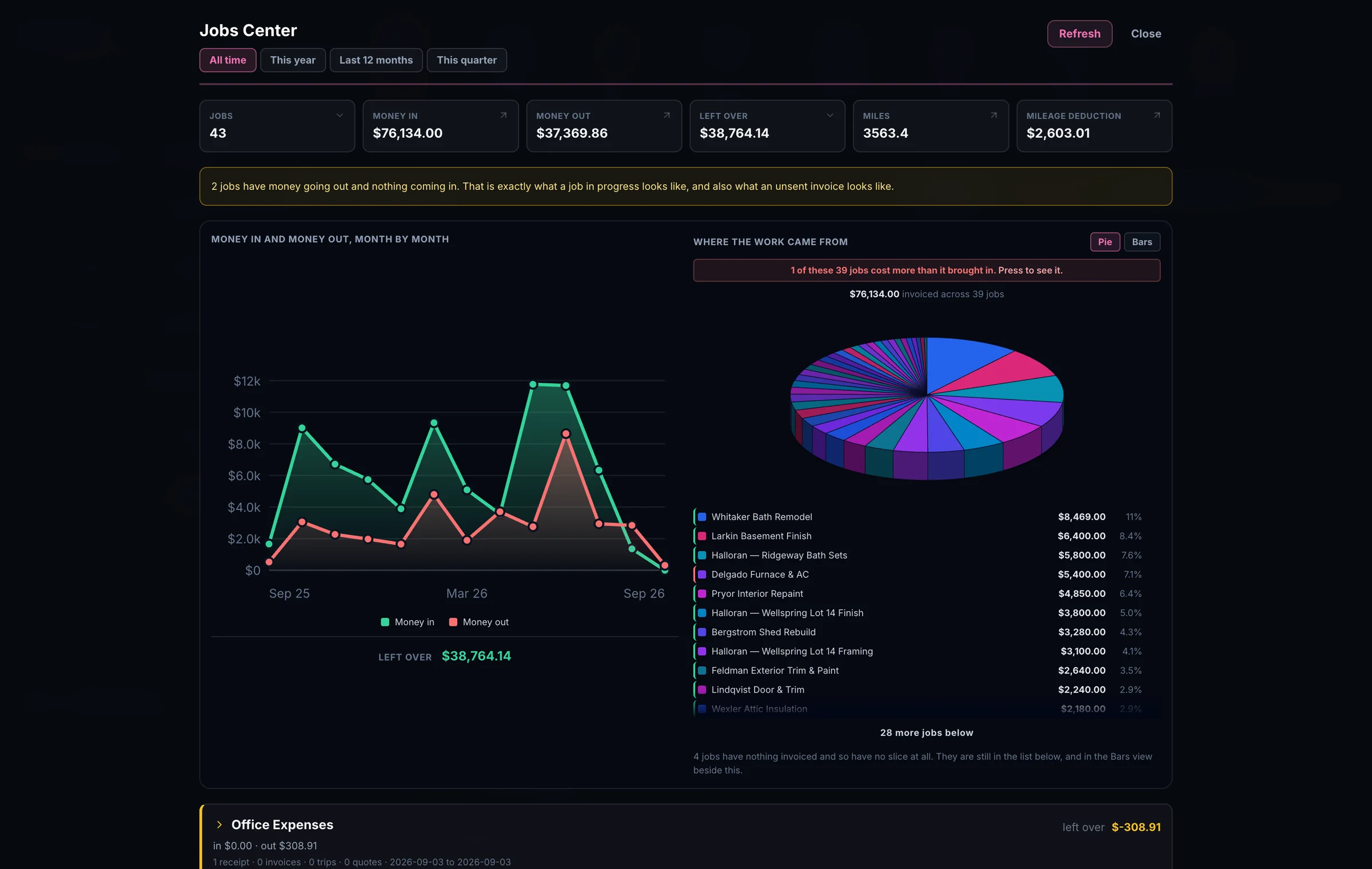
Hardly anyone knows this number, because working it out means adding up a year of jobs by hand. One glance at the wheel and you can see it. Eleven percent is one answer. Sixty is a very different one.
A job is whatever you type, and the list suggests itself from the jobs already in use. Anything that makes you build a list first would be asking you to do paperwork in order to file paperwork.
Jobs Center
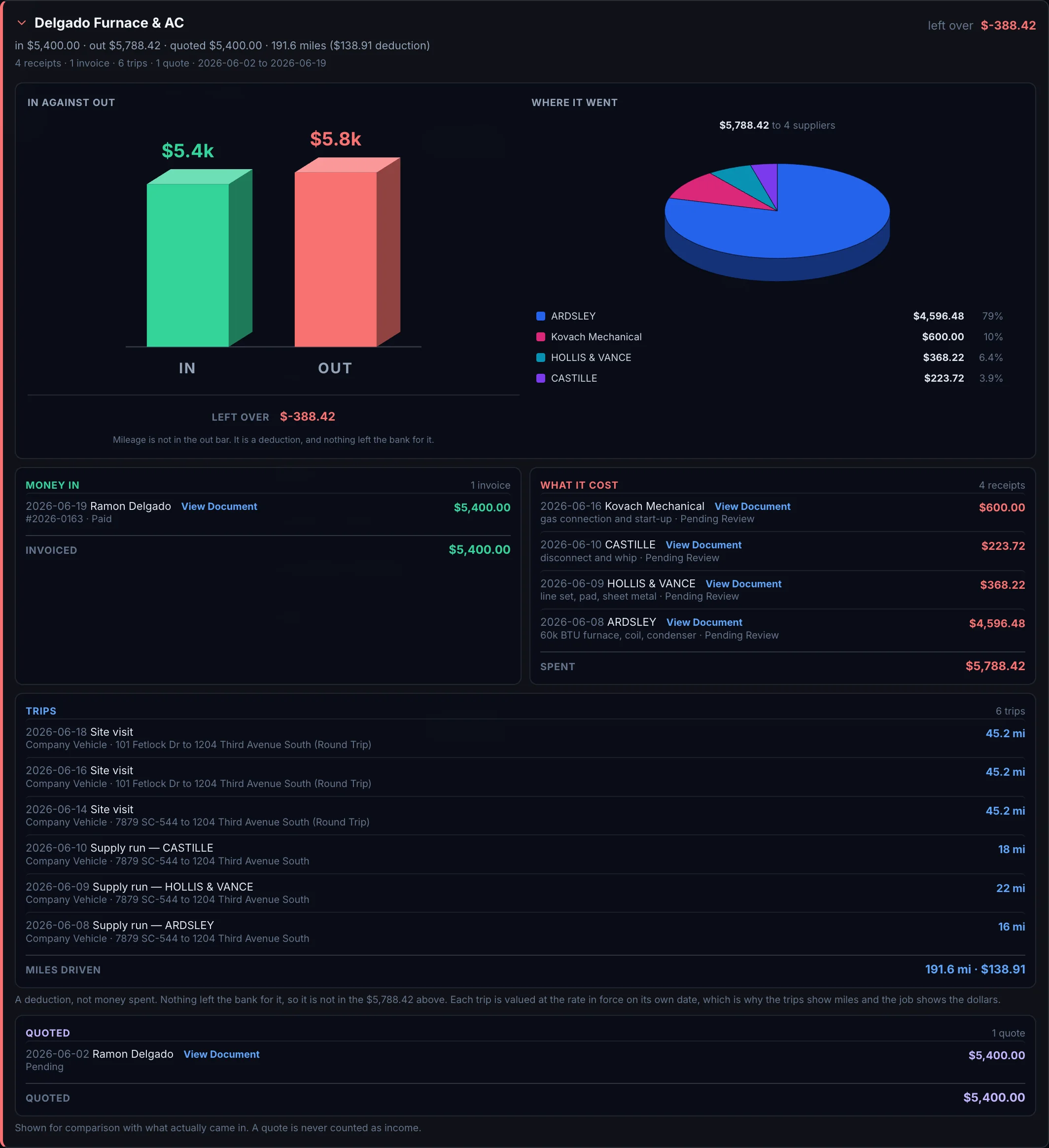
Open one and it shows you. This one invoiced $5,400 and spent $5,788.42 on four suppliers, so it lost $388.42. Nobody was ever going to work that out until the end of the year, and by then it would be too late to price the next one differently.
The invoice, every receipt that went into it, and all six trips are on the same screen, each one still one press from the photograph it came off.
One of these 43 jobs cost more than it brought in. Global Office: Sync found it from paper you'd already scanned.
Earning Center
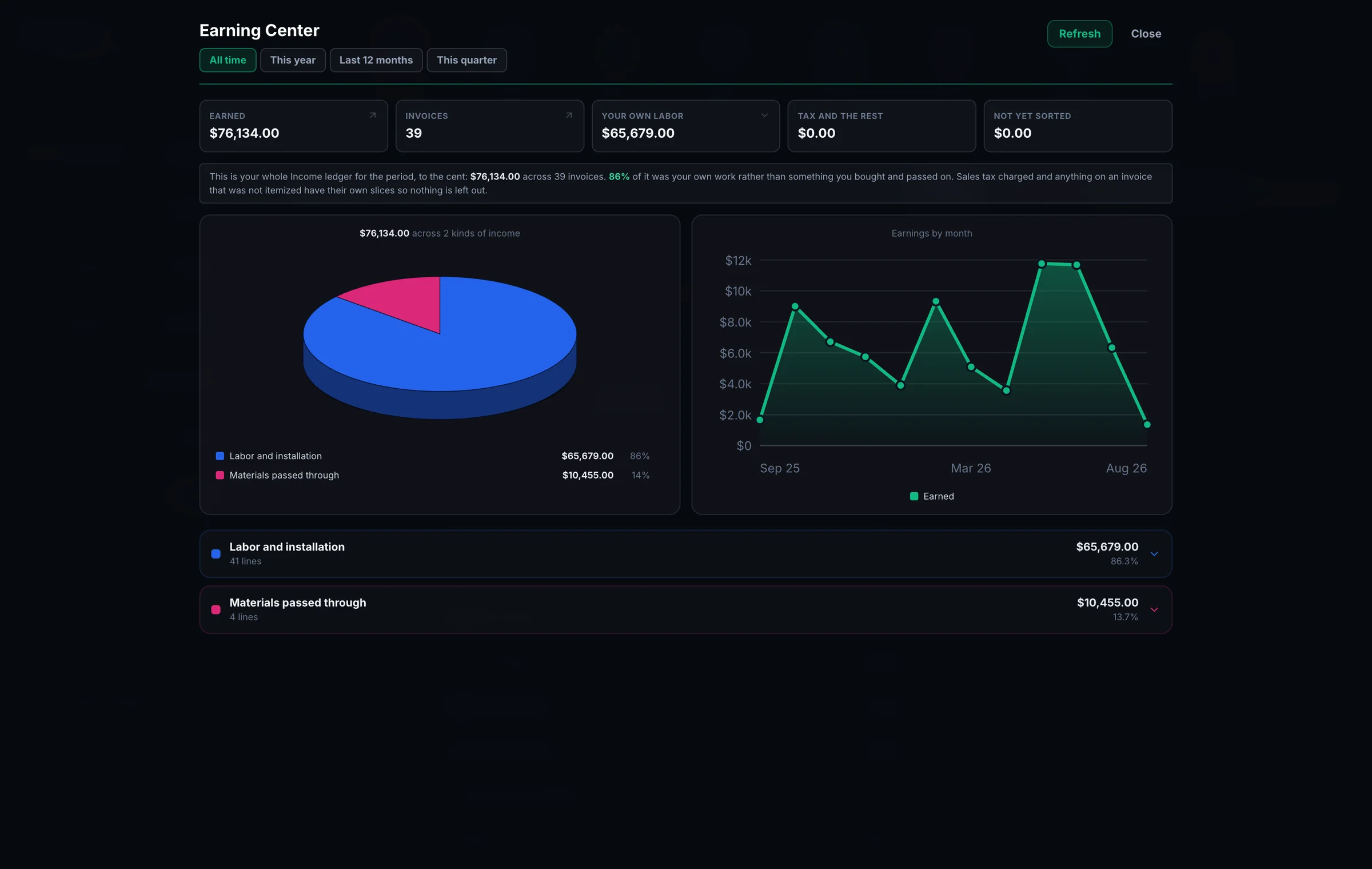
An invoice total doesn't say how much of it was your own time and how much was materials you bought and passed straight through at cost. Global Office: Sync reads every line, so it can.
$65,679 of your own work. $10,455 of materials. That's the number that decides whether you're busy or profitable.
Spending Center
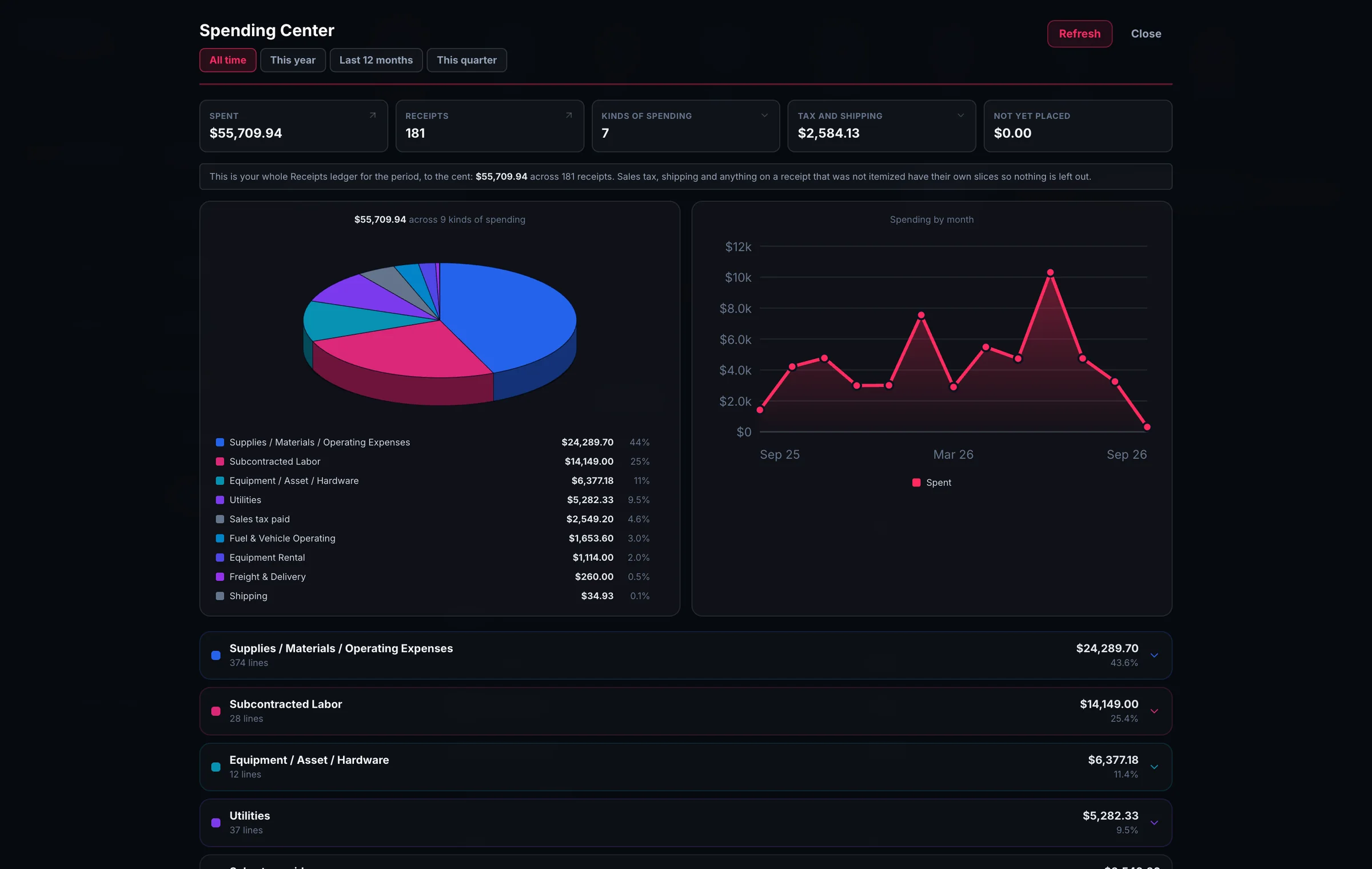
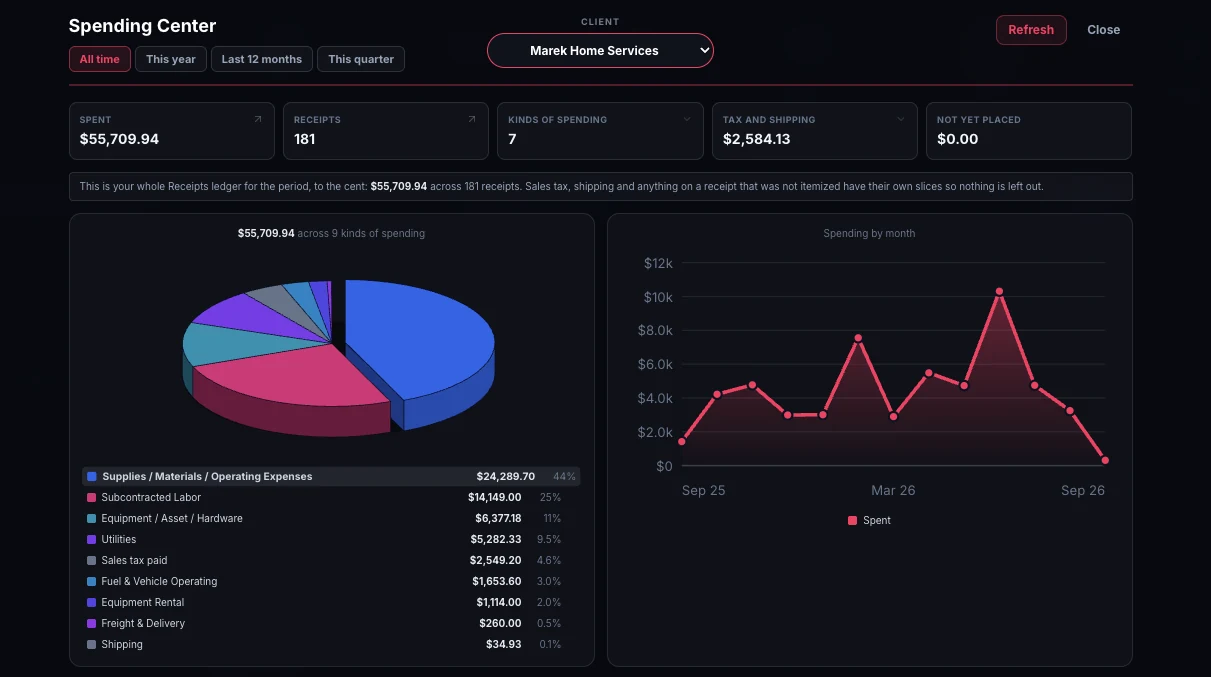
Not which supplier. What the things were. Lumber, roofing, fasteners, subcontracted labor.
Global Office: Sync already read the lines on your receipts, so there's nothing to set up first.
Mileage Center
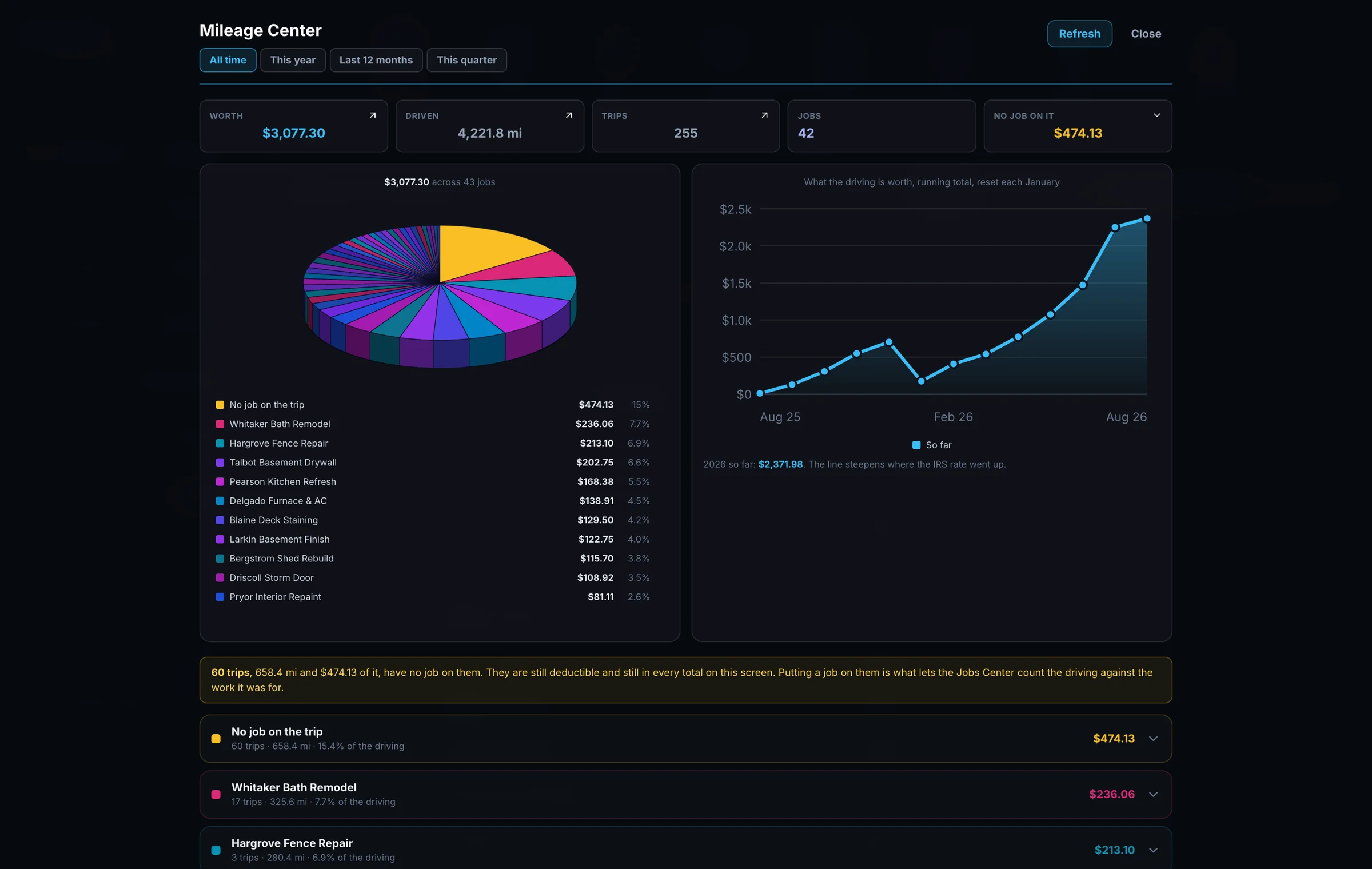
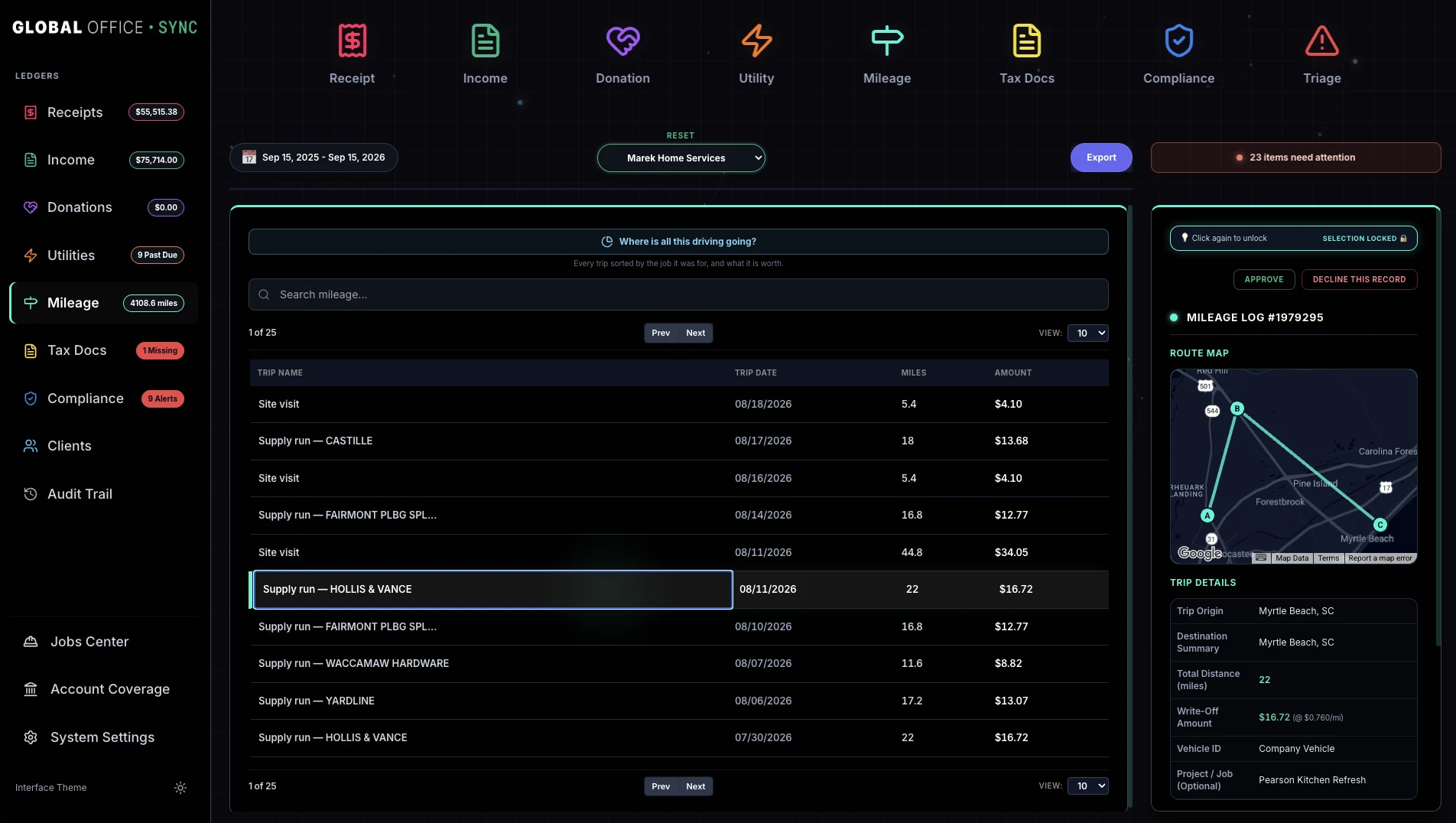
This one tells you what the driving is worth: $3,077.30 across 255 trips and 42 jobs, each one valued at the IRS rate in force on the day it was driven. Not this year's rate. That day's rate.
The running total has a visible kink in it where the IRS moved the rate partway through 2026, which means everybody still using "the 2026 rate" has been wrong for half the year and does not know it.
Bills Center
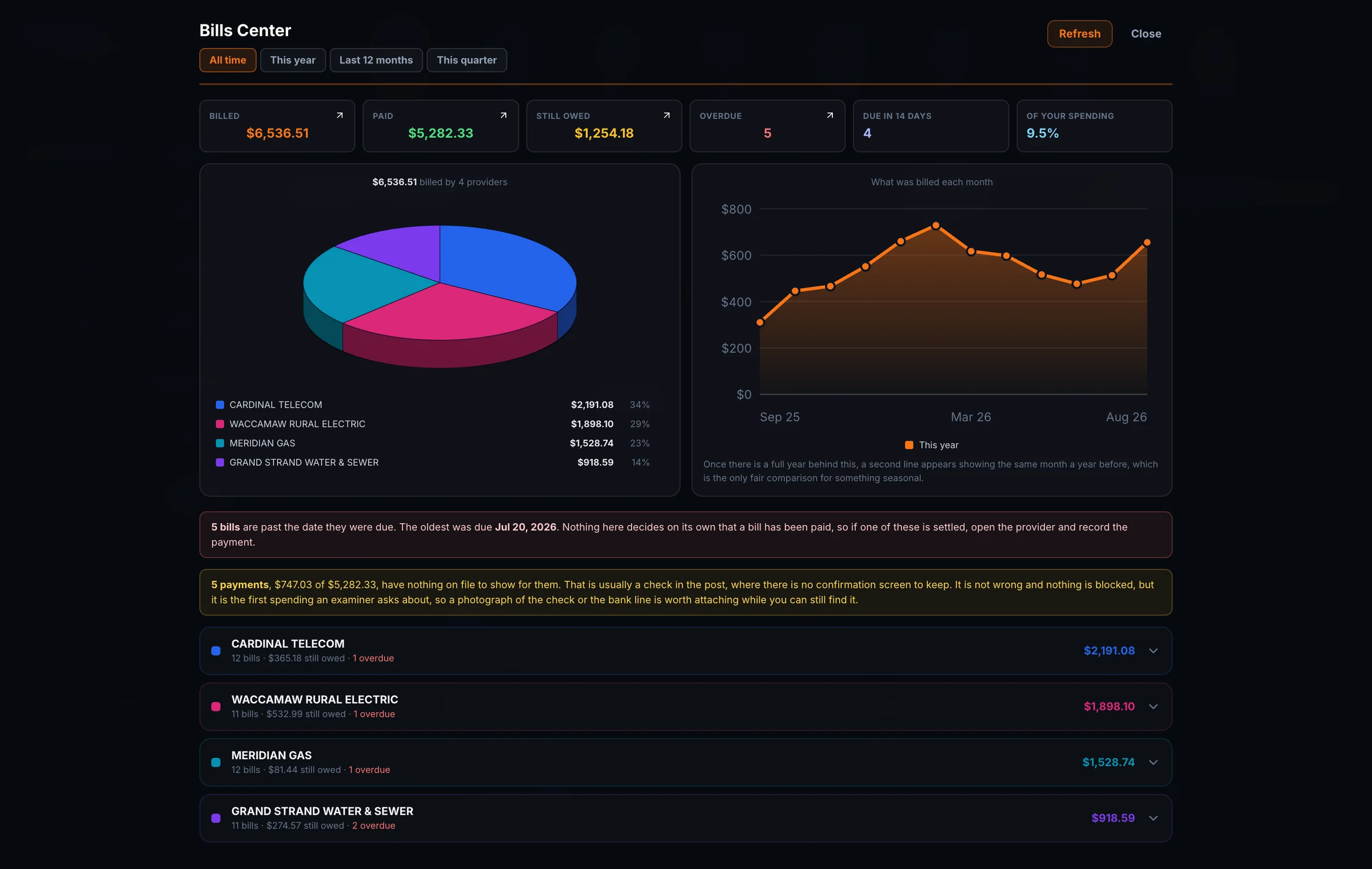
Not a count. A date. Five bills past due and the oldest was due on July 20th, per provider, with what falls due in the next two weeks beside it.
Settle one and record the payment on the same screen. A payment is a real expense here rather than a tick, so a bill can be part paid, paid by two methods, or taken back. It never decides a bill has been paid. Only a person does.
It also tells you that $747.03 of what you have paid has nothing on file to show for it, which is almost always a check in the post, and is the first spending an examiner asks about.
Price history
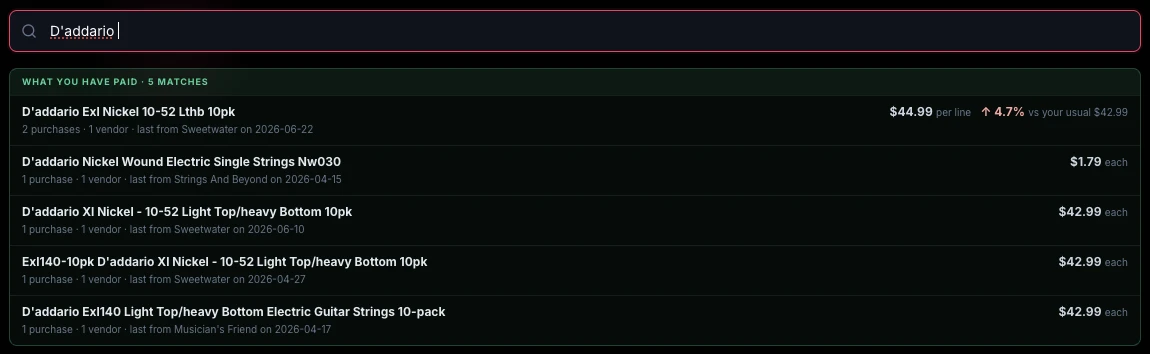
The app knows that because it read your receipts. All of them, down to the line, and it puts the price in front of you while you are searching rather than hiding it behind a menu.
What you last paid for a thing, and where, is not a record of money you already spent. It is the number you need when you are pricing the next job.
Contact Center
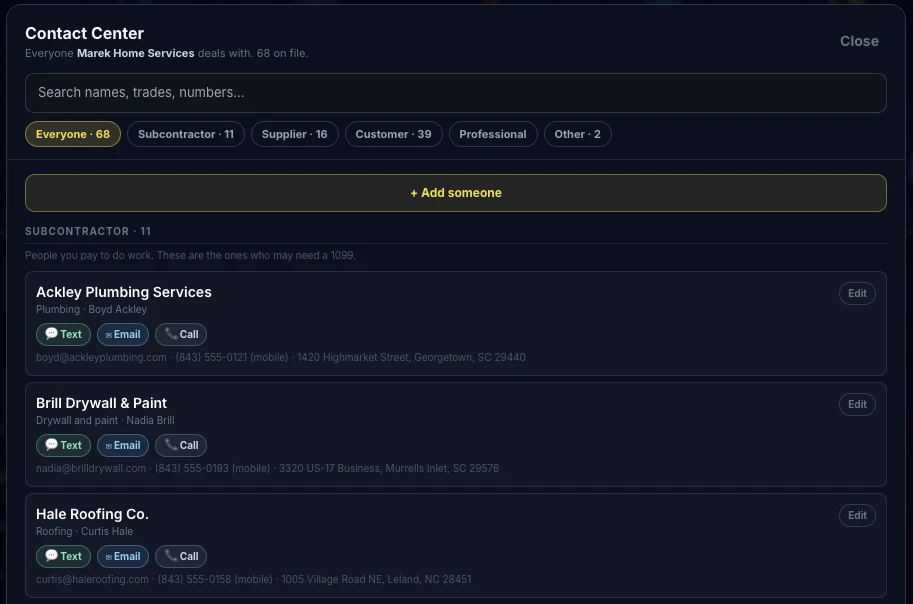
You never built this list. It assembled itself out of the documents you photographed, with the phone number and email you already had for each person, reachable from the record you happen to be looking at.
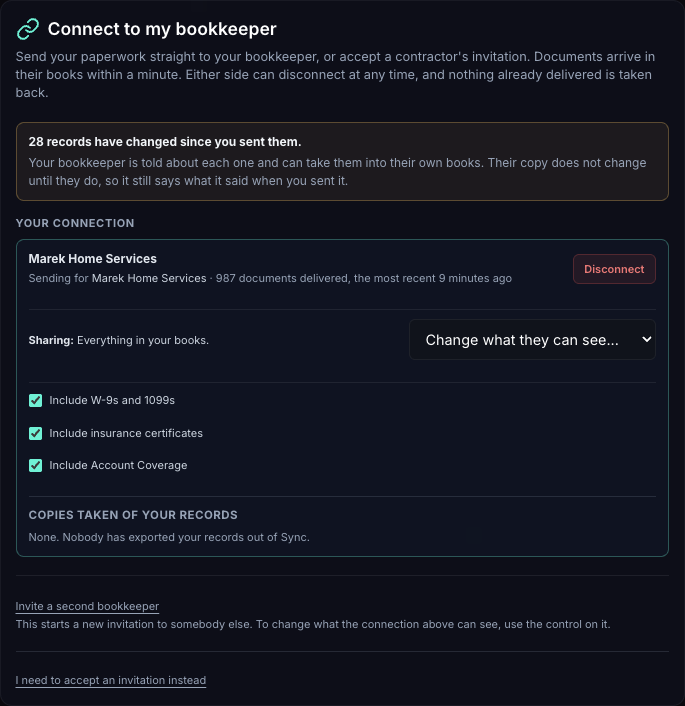
Approved records cross over as copies with the document attached. The contractor decides how far back the bookkeeper can see and whether their Account Coverage goes too, and can change either later. The business details travel with the invitation, and either side can cut the link at any time.
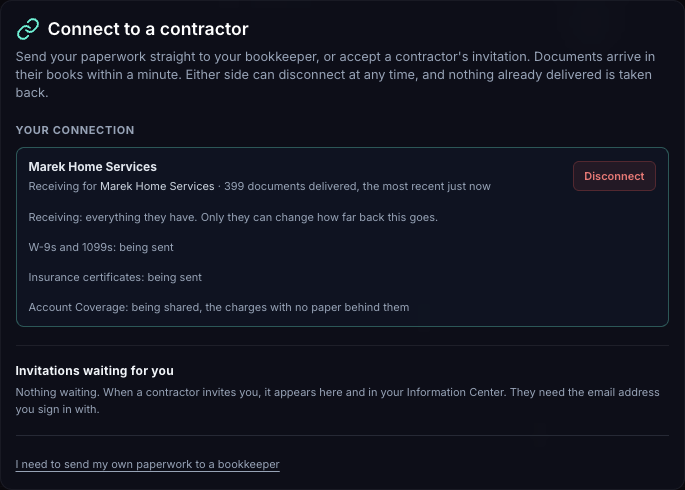
The bookkeeper can mark a bill paid and the contractor is told within the minute. Nothing else crosses back: the bookkeeper can say what they did, and they cannot change what the contractor said.
Asking a client for documents · Full Edition
Chasing them for paperwork is the part of the job nobody bills for, and a client portal fails for one reason: clients won't log into it. So there's nothing to log into. Make a link for one client and type what you need. They open it on their phone and add photos or PDFs. No account, no password, nothing to install.
Global Office: Sync can send it for you as a finished email with a Send your documents button on it, in your name, and replies come straight back to you. Or copy the message into a text and send it yourself.
The message is exactly what you typed, with the link under it. Every link expires, and you can withdraw one at any time.

The client's page says who is asking and what for, and nothing else. It never shows a figure, a document, or anything sent before.
They say what each one is and press send. A blurry or dark photo is caught right there on the phone, with Retake photo or Use it anyway, before anything goes.

Every document is scanned the moment it arrives. None of it goes into the books until you've looked at it.
Review opens the ordinary review screen, already filled in and already on the right client. Accept it, correct it, or decline it with a reason the client never sees. Once everything sent has been dealt with, the request closes itself.

Built for the phone first
Not a companion app with three buttons on it. The same ledgers, the same findings, the same jobs, on the screen you actually have with you. The receipt is in the van, and so are you.


Getting the paper you are missing

When the app notices a subcontractor has no W-9, or that a certificate of insurance has run out, the card that tells you carries a button that asks them for it. Their name, their email and their phone are already filled in, out of your own paperwork.
And the message is already written, in words that fit the reason: a certificate that expired, one that is about to, one that never covered the work, one reissued with less cover than the last, a 1099 you are getting in order, a quote nobody came back on. It hands the finished thing to your own messages or your own email, so it goes from you rather than from a robot. Change a word of it or send it as it stands.
You do not have to type anything. That matters because chasing paper is the job nobody does until it is too late, and the reason is never that it was hard. It is that it was unpleasant to start.
The Information Center
Things go in, and later you can find them again. Most of them won't tell you about the utility bill that never arrived, because a bill that didn't come has no transaction to notice. And that's the one that costs you.
Compliance and certificates
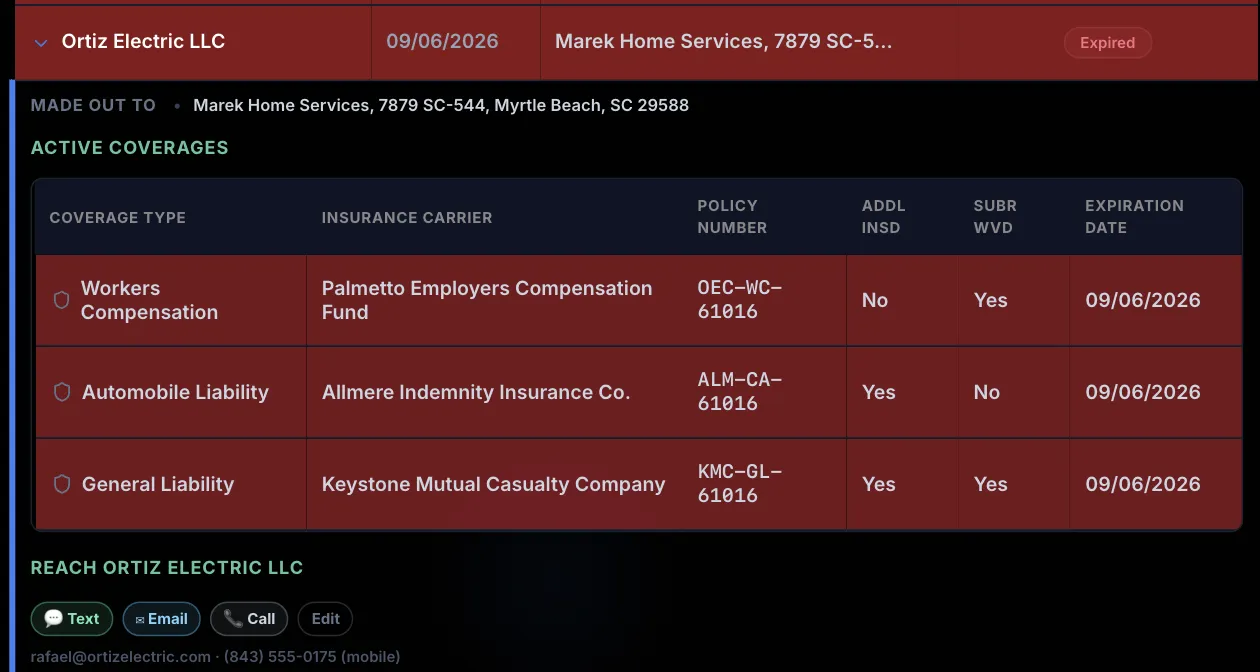
Once is once you can miss, so it appears in three separate places. A certificate made out to a different company is flagged too, in amber, because in force is not the same as covering you.
Tax Docs
That is a rule you could look up. This names the subcontractor, the payment that took them over the line, and what you still need before you can file. Nothing is late when it says so, which is the point: chasing an address and a tax number in January is the part that goes wrong.
Tax identification numbers are stored locked, and shown as dots.

Account Coverage
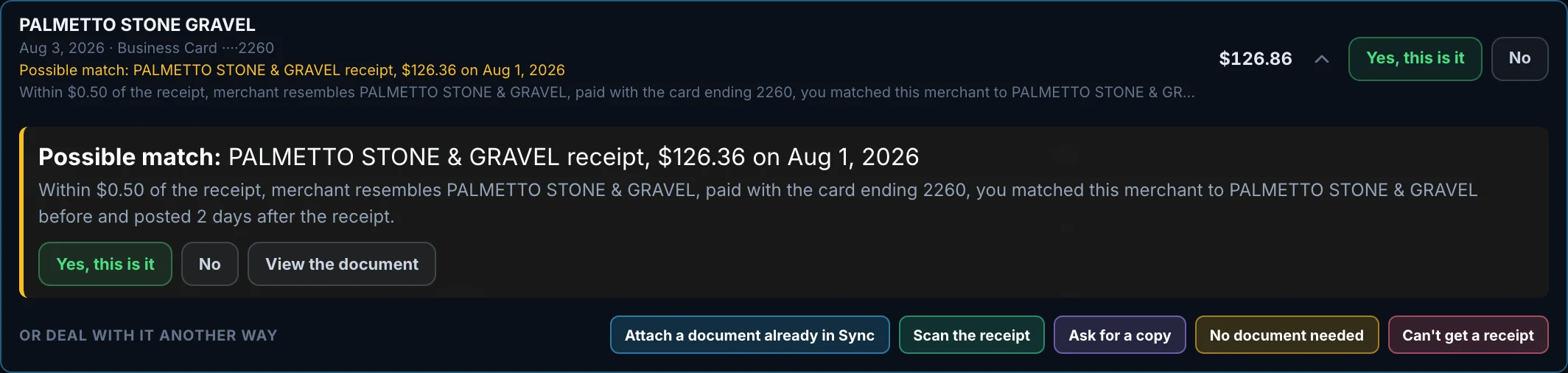
Connect a bank or card account and Global Office: Sync holds every charge up against the receipts, bills and invoices it already has. What comes back is the list your accounting software cannot give you: the charges with nothing behind them.

The Export Center
Global Office: Sync is not an accounting system and does not want to be. It feeds the one you already have: no migration, no retraining, and no risk to books that already exist. Both editions send to all three.

The Audit Trail
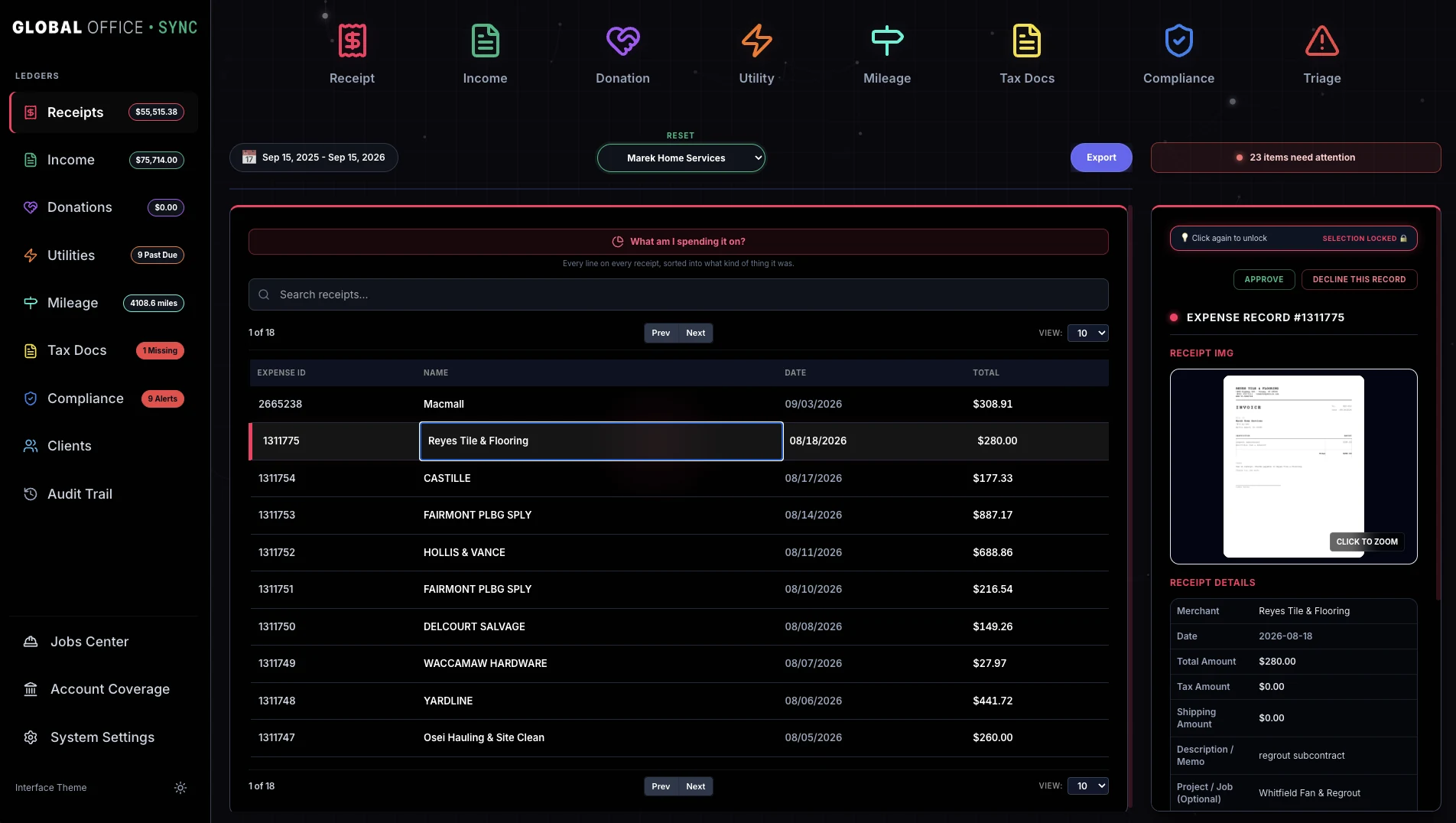
Every field the scanner proposed and every one you corrected is kept side by side, permanently, with the source document attached. When a client asks how a number got there, or an examiner does, you can show them the whole chain from photograph to ledger.
Every entry says which account made it, by name. Not an internet address. A name. "I do not know who changed that" is not an answer you should ever have to give a client.
The trail cannot be edited. By anybody, including the person who built it.
An entry cannot be altered or removed after the fact, and the database refuses it rather than the app simply not offering a way. That is the difference between a promise and a design.


Four documents you can hand to somebody
Two looks
Global Office: Sync opens in Luminous Dark. If you'd rather work on something closer to paper, Tailored Light is one press away, and switching back is just as quick. It's the same interface either way, with every button where you left it. Only the style changes.

The part nobody advertises
Silence is the fault that costs the most, because a record that quietly went nowhere is one you find out about from an auditor rather than from your app.
What changes between them is how much the app has to ask you. An edition with nobody working for you never mentions certificates of insurance. An edition running one business never asks which business this is.

Runs against every client's real chart of accounts, pulled from their own books. One client's records cannot be reached from another's account, and the isolation is enforced in the database rather than in the interface, so it holds even if the interface has a bug. It opens on the whole practice, and asks a client for documents with a link that needs no account.

No chart of accounts anywhere, no client switching, and it never asks which business this is. Gets Quotes and Compliance, because a contractor who hires subcontractors is the person who needs certificates watched most. Built for a phone in a work truck.

Musicians, drivers, photographers, trainers, and anybody else filing a Schedule C on their own. Contractor Edition with everything about hiring people taken out. Not built yet, and the price is already set.
In a category where every product promises to do more, these are decisions with reasons behind them.
There is nothing to install. It runs in the browser, adds itself to your home screen, and updates itself with no app store in the way.


